
The Olfactory Attribution Circle Jerk
How to decode an academic abstract.

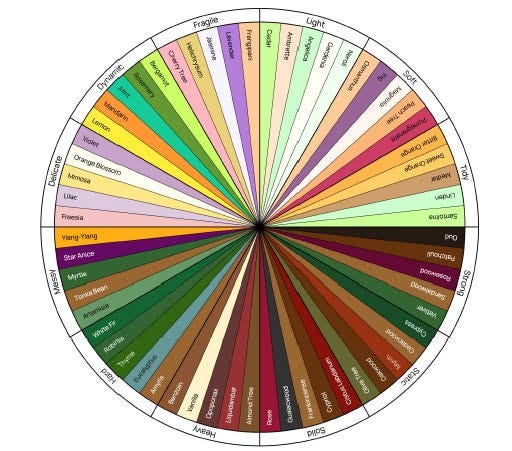
Fig. 5 from Tonin & Ferrara, 2025
If you’ve been reading academic papers as long as I have, you develop a keen nose for bullshit. Sometimes the stink hits you halfway through the abstract and you can press delete and get on with your life. A few days ago, a paper in the journal Architecture lit up so many warning signs I was about to vaporize it. But instead, I decided provide a first-hand account of the experience.
Initially, Olfactory Attribution Circle (OAC): Designing crossmodal congruence between scent, color, and language, looked to be right up my alley. I was curious how the authors, a pair of Department of Design professors, would apply the topic to the practice of architecture. So I plunged into the abstract.
This article introduces the Olfactory Attribution Circle (OAC), a conceptual tool for integrating olfaction, color and semantic attributes in the design of sensory atmospheres.
Warning sign #1: leading with a novel acronym.
Warning sign #2: wtf is the “design of sensory atmospheres”?
Developed through a multi-method strategy, the research combined a literature review, semi-structured interviews with academic and industry sources, a case study of Every Human (Algorithmic Perfumery), and AI-assisted exploration.
Warning sign #3: “semi-structured interviews” = “we talked with some colleagues over cappuccinos.”
Warning sign #4: wtf is “Algorithmic Perfumery”?
Warning sign #5: “AI-assisted exploration” = “we had no hypothesis, no idea of what we were looking for, so we handed off to an AI.”
The review revealed a lack of tools operationalizing olfactory design within the built environment.
Two professors of architecture needed to do a literature review to arrive at this blindingly obvious conclusion?
Interviews provided practice-based insights on inclusion, intensity calibration, and feasibility, while the case study demonstrated the potential and limitations of AI-driven personalization.
The interview probably went something like “Yeah, you can scent a building, but you probably don’t want to over-do it. And you’d have to figure out how to deliver scent through the HVAC. Hey, do you mind if I order a biscotti with my cappuccino?”
AI was employed to generate mappings between 60 essences, semantic attributes, and chromatic codes, refined through authorial curation.
Translation: “We sent the AI bot on a fishing expedition and dicked around with the results until we could tell a story.”
Results highlight systematic crossmodal correspondences between scents, linguistic attributes, and chromatic values,
No shit Sherlock. Some of us spent hundreds of hours conducting, you know, actual experiments on these topics and describing the resulting crossmodal correspondences.
. . . underscoring the importance of crossmodal congruence in designing coherent sensory experiences.
Crossmodal congruence has been a major theme in the multisensory literature for decades. But give the authors credit for “underscoring” it.
The OAC enables congruent, human-centered olfactory design, though cultural variability and semantic ambiguity limit universal application.
Human-centered? As opposed to what? Buildings designed for squirrels?
The study positions the OAC as both a methodological contribution and a foundation for future empirical testing across diverse cultural contexts.
Translation: “We’re going to keep promoting this acronym until our colleagues start citing us. After all, we bought the cappuccino and biscotti.”
You can read all twenty-six pages of this masterpiece for yourself. (Fair warning: you’ll need plenty of espresso to power through it.) The payoff from the whole exercise is . . . yet another Wheel, pictured above. You can file it along with the descriptive wheels for wine, coffee, tea, beer, and cannabis.
You won’t be shocked to discover that the authors, Paulo Eduardo Tonin and Marinella Ferrara, are globe-trotting, European sophisticates conversant in the latest academic jargon.
Always at the frontier of emerging design paradigms, Paulo is committed to advancing experiential design as a transformative tool for cultural relevance, regenerative thinking, and authentic human connection.
As for Professore Ferrara:
her research investigates the strategic role of materials in design-driven innovation, both historically and in contemporary contexts. Her current focus lies on new materials and materialities —particularly related to smart and adaptive materials, bio-based e waste-based materials—in relation to the twin transition (digital and ecological) and emerging approaches to design education, craftsmanship, and manufacturing.
Here in Fort Collins, Colorado, there’s an architect I’ve met a couple of times. She designed several buildings for the local school district, as well as the Presbyterian church down the block. She’s never mentioned emerging design paradigms nor is she focused on materialities. On the contrary, she’s perfectly normal.
Paulo Eduardo Tonin and Marinella Ferrara, Olfactory Attribution Circle (OAC): Designing crossmodal congruence between scent, color, and language. Architecture 5:121, 2025.
This wheel is making my brain break. I sent my friend your article, and they immediately called me to talk about it
Even a cursory glance at that wheel… sigh. It’s another attempt at shoehorning scent into a pretty graphic.