
Science Goes Downtown
The search for olfactory cues to female fertility

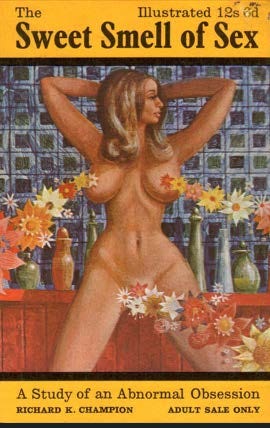
Human pheromones were all the rage in the 1990s. It began with D. Michael Stoddart’s scholarly book The Scented Ape: The biology and culture of human odor (1990). Then came The Scent of Eros: Mysteries of odor in human sexuality, by James Vaughn Kohl and Robert T. Francoeur in 1995. Three years later Michelle Kodis, along with David Moran and Deborah Houy, published Love Scents: How your natural pheromones influence your relationships, your moods, and who you love.
While popular interest eventually moved on to other topics, scientific investigators of the link between sex and scent soldiered on with mixed results.
Research into human body odor has two major challenges: figuring out the chemistry of the scent and decoding its evolved biological signal (if any). An impressive recent study looked at the chemistry and perception of olfactory female fertility cues, using samples of vulvar odor. We know that females of other primate species advertise fertility by various means; these include the flamboyant sexual swelling seen in chimps and baboons, as well as ano-genital odors that are perceptible by males. Whether or not human females produce similar olfactory cues is still open to debate. Some studies have found evidence for axillary and vulvar odor cues, yet others have found none.
The new paper, led by researchers from the Behavioural Biology Research Group and the Max-Planck-Institute for Evolutionary Anthropology at Leipzig University in Germany, set out to characterize the chemistry of vulvar volatiles across the fertile portion of the female cycle, and to measure their perceptual impact on male raters.
Twenty-eight women served as odor donors, and 139 men served as odor raters. In previous studies from years ago, a big issue was imprecision in knowing the cycle stage of female odor donors. The German group collected repeated saliva samples from their volunteers and ran highly sensitive immunoassays for estradiol and progesterone levels. This gave them a much better fix on ovulatory timing. The female volunteers collected vulvar scent for sniff analysis by wearing a cotton gauze pad in their underwear for 12 hours overnight. For chemical analysis, they used an air pump to self-sample vulvar scent into absorbent-lined stainless steel tubes. Carrying out this complex protocol took a lot of work, especially given covid-related restrictions in force as the time.
Chemical analysis of the vulvar volatiles was done with gas chromatography-mass spectrometry. The goal was to identify compounds that changed concentration in the days leading up to, and following, ovulation. Despite a sophisticated analytical approach, the team did not find any molecules that reliably changed with the cycle. So much for vulvar scent volatiles providing a clear chemical cue to female fertility.
What about the sensory evaluations? Each male panelist sniffed odor samples from 24 different women across two sessions. They rated the scent for attractiveness, pleasantness, and intensity using an 11-point scale. If you’re keeping score at home that’s a total of 2,947 sniff evaluations. Despite this impressive number of data points, the sensory results produced no consistent pattern with respect to ovulation timing or hormone levels.
Where does this leave us? One possibility is that the link between fertility status and ano-genital odor was broken when humans became bipedal. A related point is that modern habits of clothing and hygiene have reduced whatever signal may still exist. To minimize diet-induced changes in BO, the female volunteers in this study were required to eat a vegan/vegetarian diet. This might have had the inadvertent effect of reducing odor changes that would emerge in a more evolutionarily realistic (meat-included) diet. In an aside, the authors also note that they did not give their subjects “specific instructions about vulvar hair shaving,” which might be a variable that “warrants further investigation.” [Dude. Really?—Ed.] [It’s a scientific imperative; this is no time to beat around the bush.]
Serious researchers like Zetzsche et al. will no doubt keep searching for an olfactory cue to human fertility and sexual attractiveness. They may even identify a molecule or two that send a reliable biological signal. But the days of fantasizing about human pheromones seem long past. As olfactory scientist Dick Doty wrote sixteen years ago1, “evidence for the existence of human pheromones is weak on empirical, conceptual, and methodological grounds.” Despite best efforts, that remains true today.
Madita Zetzsche, Marlen Kücklich, Brigitte M. Weiß, Julia Stern, Andrea C. Marcillo Lara, Claudia Birkemeyer, Lars Penke and Anja Widdig, Understanding olfactory fertility cues in humans: chemical analysis of women’s vulvar odour and perceptual detection of these cues by men. Evolution and Human Behavior 46:106742, 2025.
The Great Pheromone Myth, by Richard L. Doty. The Johns Hopkins University Press, 2010.