
Olfactory Notes from the OR
A surgeon appreciates why smell matters

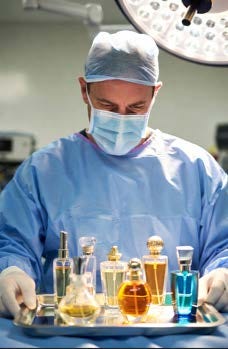
People newly arrived in Perfume Land—the online world of fragrance discourse—might get the impression that smelling is all about personal memories and feeeeelings. Perfume Land is a free-form playground of invention where anyone can posture and perform. Your subjective olfactory truth is totally valid and as good as anyone else’s. At least according to the online ethos.
In the real world, however, the creation and production of fragrance is a craft. Elements of it can be taught, but ultimately you have to live it to learn it. Smelling in a professional setting is practical skill—it’s about recognizing acceptable variation in raw materials and the tell-tale notes of oxidation or contamination. It’s about detecting off-odors in finished goods and having a feel for how a shampoo base releases its top notes in hot water. Such smell knowledge isn’t always sexy but it has a logic and utility of its own. In the real world, the practical is paramount. People with hands-on experience are valued for their sound judgment, not for their shared feelings.
Specialized smell knowledge is what olfactory researcher Melanie McBride calls a “physically embodied practice.” It also exists beyond the perfume industry. Brewers and chefs have it and so, evidently, do some surgeons.
Dr. Oǧuzhan Taș is a member of the Department of General Surgery at the Aksaray Training and Research Hospital in Aksaray, Turkey. He just published a “Perspective” piece in the Journal of Surgical Education in which he argues that smell should be included as part of clinical reasoning when training future surgeons.
He describes aspirating a breast cyst in a female patient and being able to reassure her—even before sending the tissue to the pathology lab—that the cyst was most likely benign. How did he know this? Because of its “distinctive and reassuring scent.” As Dr. Taș puts it, the “odor did replace pathology, but it shaped clinical judgment long before the report arrived.”
Taș offers other examples of smells that can inform medical diagnosis:
The faint sweetness of diabetic ketoacidosis. The pungency of necrotic tissue. The unmistakable odor of an anastomotic leak. The first removal of a heavily colonized dressing. These cues are often discussed informally—on ward rounds, in operating rooms, and through mentorship. However, they are seldom described in written surgical texts or explicitly incorporated into structured curricula.
Taș understands that imaging technologies and robotics are advancing the practice of surgery, and that formalizing standardized assessments improves medical training. Yet he cautions that in pursuing these ends “aspects of embodied clinical reasoning risk becoming less visible—not because they lack value, but because they resist easy quantification.”
Olfactory cues are variable and context-dependent. They are not universally reliable. However, they contribute to pattern recognition, hypothesis generation, and early clinical suspicion—core components of clinical reasoning.
This is a cogent plea for the recognition and acknowledgment of olfaction as a valuable dimension in clinical training—in both the OR and the clinic. And it resonates with those of us who learned how to smell for a living.
Oǧuzhan Taș, Olfaction in surgical education: An overlooked dimension of clinical reasoning. Journal of Surgical Education 83:103985, 2026.
Yes, more of this please. Always appreciate your insights Avery!