
Make Room for Daddy
Infants respond differently to scent of own father

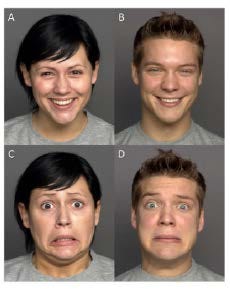
From Fig. 1 in Düfeld & Jessen (2026).
Mother-infant bonding based on smell—in both directions—has long been Exhibit A for the importance of olfaction in human social behavior. The focus is understandable given the chemosensory signals available to a baby in the womb and during breast feeding, and because mothers typically spend the most time taking care of an infant. While it is at least theoretically possible that infants recognize their father’s odor, there has been very little research into this possibility. That has changed with a new paper by a pair of researchers at the University of Lübeck in Germany.
Antonia Düfeld and Sarah Jessen had fathers of seven-month-old infants wear T-shirts for three nights to collect body odor—a tried-and-true experimental method. In the lab, infants were placed in a car seat while wearing a plastic cap containing an array of 27 electrodes to record EEG signals. A T-shirt worn by either the baby’s father or another baby’s father was placed on the infant’s chest, where it could easily be smelled. A video screen placed in front of the child displayed brief colored images of human faces (both male and female) expressing happy or fearful expressions. The EEG electrodes captured three different parameters (called event-related potentials) in response to the flashed photos.
As you can imagine, it was a quite logistical headache to coordinate T-shirt wearing by fathers and two lab appointments with mothers who often had other kids. Inevitably some infants get fussy, start crying or otherwise can’t complete a session. Still, the investigators managed to collect and analyze data for 15 boys and 15 girls.
The EEG electrodes were analyzed by Odor (father, stranger), Emotion (happy, fearful), and Face Gender (male, female). Complicated, yes, but the study design was preregistered, meaning that the statistical comparisons were locked in before testing began. In other words, no post-hoc statistical fishing expeditions.
So what were the results?
Analysis of [an EEG response called] the frontocentral Nc amplitude revealed an enhanced response to fearful compared to happy male faces only when infants smelled their own father but not when they smelled an unfamiliar father. In contrast, emotion processing [represented by EEG response] at the occipital N290 was not affected by the presence of paternal odor . . .
Coming back out of the weeds, the EEG results suggest that the olfactory presence of an infant’s own father has an impact on attention to adult faces, but not on the emotional processing of those faces. Also intriguing is that the significant odor effects “were specific to male faces, pointing to a gender‐specific impact.”
Clearly, seven-month-old infants already have a lot of olfactory and cognitive abilities. They can process happy and fearful male faces differently, and they modulate that facial processing depending on whether they are smelling their own father or someone else’s. It’s time for scientists to start including fathers in their studies.
Antonia Düfeld and Sarah Jessen, How does paternal odor influence perception of fearful and happy faces in infancy? Infancy 31:e70081, 2026.
So interesting. Scent not shaping our responses, but our actual attention. Built-in from the beginning.