
Are You Ready for a Bionic Nose?
Setting the ground rules for experimental olfactory implants

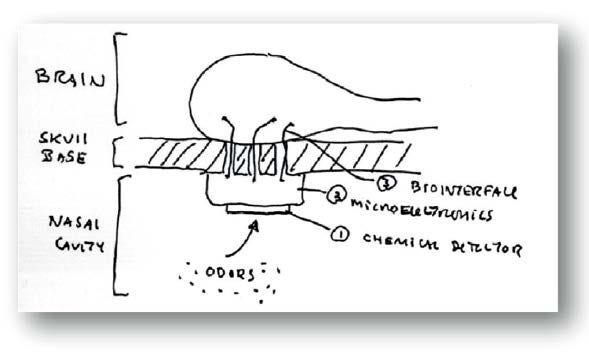
Invention notebook sketch of putative olfactory implant by R.M. Costanzo, dated Dec. 14, 1998.
We don’t give much thought to glasses or hearing aids because restoring visual or auditory perception with external devices is no big deal. But a surgically implanted device that interfaces with the central nervous system is an entirely different ballgame. Consider cochlear implants to restore hearing in profoundly deaf people—the technology is impressive, but it must be “tuned” for optimal results. Even then, the quality of restored hearing varies from patient to patient, and the procedure carries risks.
What about a similar approach for smell? After all, anosmia is far more common than profound deafness or blindness.
We have known since 1881 that applying electrical stimulation to the nasal cavity can produce an odor perception—Julius Althaus was the experimenter and the result was a “phosphorous smell.” In the 1950s, Wilder Penfield and Herbert Jasper (of homunculus fame) stimulated different brain areas of epilepsy patients undergoing surgery; when they zapped the olfactory bulbs patients experienced odors. Many studies since then have confirmed these basic insights.
In 2016, Richard M. Costanzo and Daniel Coelho of Virginia Commonwealth University were granted a United State patent for an “olfactory implant system.” Their concept involved chemical sensors linked to an electrode array that would stimulate the olfactory cortex, e.g., the olfactory bulbs, thereby creating a pattern of neural activity mimicking an odor perception.
With increasingly sophisticated micro-electronics and more detailed brain stimulation research, we are on the cusp of an electronic olfactory implant system that might restore at least basic function to people with severe smell loss. The logic is clear, but it raises a host of practical issues about safety, patient selection, and outcome measurements.
Most of these issue are addressed in new paper co-authored by thirty-eight clinicians and smell scientists from around the world. The paper is a product of a huge literature search and two steering group discussions held in 2023. The group used a modified “Delphi” process, which is a formalized method for reaching expert consensus on specific statements regarding medical interventions.
The topics they tackled include patient eligibility factors, pre-op clinical assessments, extent of smell loss, etc. They recommend that all patients should have tried and failed existing treatments, and that they should receive a structured program of olfactory rehabilitation following implant surgery. They also seek to balance risks and benefits:
In early phases of development, achievable olfactory perception and consequent benefit to risk ratio may not be sufficient to justify implantation in patients with milder degrees of impairment.
Similarly, the group suggests that patients with parosmia may not be ideal candidates for implants, since distorted odor perception may be the result of “miswiring” of brain circuits that would not be remedied by stimulation. The group provides reasons why smoking is a contraindication for olfactory implants, and they also list potential major and minor complications of the procedure.
I applaud the caution and thoroughness displayed by the authors of this paper. They have set out clear boundary markers for exciting yet risky advances in brain/electronic interfaces for people suffering from smell loss. Their recommendations will go a long way toward reassuring the public as well as patients that these experimental interventions are conducted in a reasonable manner.
Katherine L. Whitcroft, et al., Olfactory implants: international opinion paper on emerging technologies and clinical applications. Rhinology 63:1-37, 2025.